 Color Ring
What Is a Mandala? Meaning, Symbols and How to Color One
What a mandala is, what the word means, the parts and symbols of a mandala, a short history from Tibet to coloring books, and how to color one step by step.
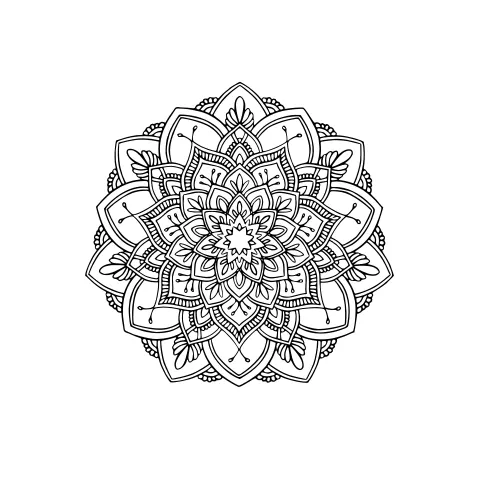
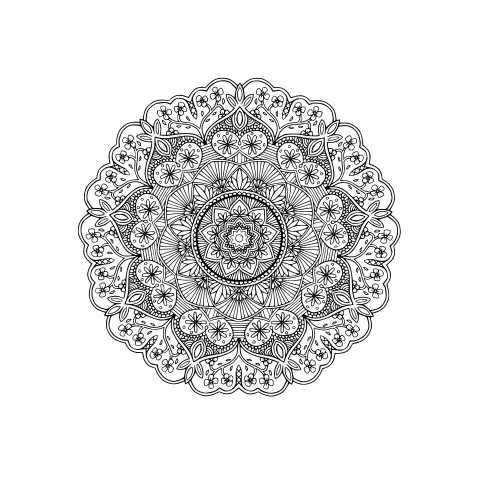
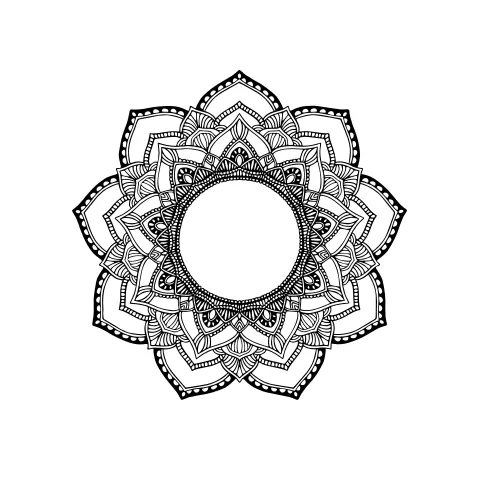
A mandala is a design built around a center point, with shapes repeated in rings so the whole picture is balanced in every direction. The word comes from Sanskrit and means “circle”. For centuries mandalas were sacred images in Hindu and Buddhist practice; today most people meet them in coloring books. This guide explains what a mandala is, what its parts and symbols mean, where it comes from — and how to color one so it looks calm and finished, not busy.
The quick answer
- A mandala is a circular design that grows outward from one center point in symmetric rings.
- The word means “circle” in Sanskrit, the classical language of India.
- It began as a sacred image in Hinduism and Buddhism, used as a map of the universe and an aid to meditation.
- Its main symbols are wholeness and balance: the center stands for the self or the source, the rings for the world around it.
- To color one, start at the center, choose three to five colors, and repeat each color around a whole ring.
What the word “mandala” means
In Sanskrit, maṇḍala means “circle”, and in older texts it also meant a circle of things that belong together — a region, a group, a whole. That second sense is the useful one. A mandala is not just round; it shows everything arranged around one center, with nothing left out of place.
That is also the answer to a common question: does a mandala have to be a circle? No. Traditional Tibetan mandalas have a square palace with four gates inside the outer circles, and many modern mandalas are star-shaped, square or flower-shaped. What makes a design a mandala is the single center and the radial symmetry — patterns that repeat as they turn around that center.
The parts of a mandala
Most mandalas, old and new, share the same building blocks. Knowing them makes a mandala much easier to color, because each part suggests a decision.
| Part | What it is | What it often stands for |
|---|---|---|
| Center (bindu) | A dot, flower or small star in the middle | The source, the self, a starting point |
| Rings | Bands that circle the center | Stages, layers of the world, the journey outward |
| Petals | Lotus or flower shapes radiating out | Opening, growth, purity (the lotus in Buddhist art) |
| Square and gates | A square with four doors (in Tibetan mandalas) | The four directions; a palace you can enter |
| Outer border | Flames, waves or a plain circle | Protection; the edge between inside and outside |
| Symmetry | The same shape repeated 4, 6, 8, 12 or more times | Balance and order |
Not every mandala has all of these. A simple coloring mandala may be just a center, three rings of petals and a border.
A short history of mandalas
India and Tibet. Mandalas appear in Hindu and Buddhist ritual art, and Tibetan Buddhism made them famous. Monks build sand mandalas grain by grain over days, then sweep the sand away at the end of the ceremony — a lesson that nothing lasts. Painted mandalas on cloth (thangkas) show deities in the center of a palace seen from above.
Other traditions. Circular designs with a strong center show up in many cultures: the rose windows of Gothic cathedrals, Islamic geometric tiles and Indigenous sand paintings are often compared to mandalas, though each has its own meaning and should be understood on its own terms.
Carl Jung. The Swiss psychiatrist Carl Jung sketched a small circular drawing in a notebook almost every morning in 1918–1919 and called these drawings mandalas. He came to see them as pictures of the mind’s search for wholeness, and he encouraged patients to draw them. That idea — mandala as a tool for calm and self-reflection — is the bridge to the coloring books we know today.
Coloring books. Mandala coloring pages became a staple of the adult coloring boom of the 2010s and are still among the most searched coloring themes. You don’t need any spiritual practice to enjoy them; their symmetry is simply pleasant to fill.
Mandala meaning and symbolism today
When people ask about mandala meaning today, they usually mean the general symbolism, which is fairly consistent:
- Wholeness — everything connected to one center.
- Balance — every side mirrors every other side.
- A journey — from the outer edge to the center, or from the center outward.
- Impermanence — especially in sand mandalas that are destroyed when finished.
Specific symbols inside a mandala carry their own meanings: a lotus for purity and awakening, a sun for energy, a wheel for movement and teaching, a star for guidance. In a modern coloring mandala, these are mostly decorative; you can give the page whatever meaning you like.
Types of mandalas you’ll see
- Teaching mandalas — traditional, full of symbols that a student learns to read.
- Healing or meditation mandalas — simpler, made to focus the mind.
- Sand mandalas — temporary, built for a ceremony.
- Flower mandalas — petals and leaves arranged in rings; the most common coloring style.
- Geometric mandalas — stars, triangles and polygons, sometimes very precise.
- Animal and nature mandalas — butterflies, birds or leaves arranged symmetrically. A butterfly is almost a mandala on its own: one body in the middle and mirrored wings.
Why coloring a mandala feels calming
The structure does part of the work for you. You don’t have to decide what to draw, only which color goes where, and the repetition settles into a rhythm.
There is some research behind this. In a 2005 study published in Art Therapy, psychologists Nancy Curry and Tim Kasser asked students to color for 20 minutes after an anxiety-raising task. Those who colored a mandala or a structured plaid pattern reported a bigger drop in anxiety than those who colored on a blank page. It was a small study, and coloring is not a treatment, but it matches what many colorists feel: a structured page is easier to relax into than an empty one.
How to color a mandala, step by step
- Pick a page that fits your time. Simple mandalas with bold lines take 20–40 minutes; detailed ones can take several evenings. Our free mandala coloring pages are grouped into simple, flower and detailed.
- Choose a small palette. Three to five colors look calmer than fifteen. A safe start: one main color, a lighter and a darker shade of it, and one contrast color.
- Start at the center. Color the center first and work outward ring by ring. This keeps your hand off finished areas and helps the design feel connected.
- Repeat each color around a full ring. Whatever you do to one petal, do to all the matching petals. Symmetry is what makes a mandala look finished.
- Alternate light and dark rings. A dark ring next to a light one creates depth and lets the shapes read clearly from a distance.
- Add gradients last. Shade each petal from dark at its base to light at its tip, all in the same direction. If you work with pencils, our guide to blending colored pencils explains layering and burnishing.
- Leave a little white. A few uncolored dots or thin rings keep a detailed mandala from looking heavy.
This short video shows a gradient mandala being colored in the Color Ring app, ring by ring from the center:
Tools. Colored pencils are the most forgiving for gradients. Fine-liner markers give flat, bright color in small cells. Gel pens are lovely for metallic centers and white highlight dots. On printed pages, use 32 lb (120 gsm) paper for markers; our guide on how to print coloring pages covers paper and printer settings.
What mandala colors mean
Color meaning depends on culture, and in a coloring mandala the “right” color is the one you enjoy. Still, many people like to pick a palette with a mood in mind. These are common Western associations, not rules:
| Color | Common association | Try it in |
|---|---|---|
| Blue | Calm, trust, depth | Outer rings, a quiet night palette |
| Green | Growth, balance | Leaves and middle rings |
| Yellow and gold | Warmth, energy | The center, sun shapes |
| Red and orange | Strength, passion | Small accents, not whole rings |
| Purple | Creativity, mystery | Petals next to gold |
| Pink | Kindness, softness | Flower mandalas, pastel palettes |
| White | Clarity, space | Uncolored rings and dots |
Free mandala and butterfly pages to start with
- Mandala coloring pages — 24 hand-drawn mandalas by artist Maria Holm, from simple to very detailed.
- Butterfly coloring pages — 18 butterflies, moths and a dragonfly, including zentangle wings that color exactly like a mandala: mirror every cell from one side to the other.
All of them are free vector PDFs that print sharp on Letter or A4 paper.
Common mistakes
- Too many colors. Every cell a different color looks noisy. Limit the palette and repeat it.
- Breaking the symmetry by accident. Before each ring, count the repeats and check that matching shapes get the same color.
- Starting at the edge. Your hand smudges the center later. Work from the middle out.
- Pressing hard too early. Heavy first layers of pencil leave no room for shading. Start light.
- Coloring everything. A mandala needs a little white space to breathe.
FAQ
Why are they called mandalas? Because maṇḍala is the Sanskrit word for “circle”. The name describes the form: a design organized around one center.
Does a mandala have to be a circle? No. Many traditional mandalas contain a square with four gates, and modern ones can be star- or flower-shaped. The defining features are one center and radial symmetry.
How do you create a mandala? Draw a center point, then a few light guide circles and straight lines through the center to divide them into equal parts (8 or 12 is easy). Repeat one shape in every section of a ring, then move outward.
Is it disrespectful to color mandalas? Coloring a decorative mandala is widely accepted. If you work with a traditional religious mandala, treat it as sacred art from a living tradition and learn its meaning first.
Is it good to keep mandala art at home? Many people hang mandalas as calming decoration, and some traditions place them in meditation spaces. There is no rule against it; choose a design that you find peaceful.
Color mandalas anywhere
If you’d like to try palettes before printing, the Color Ring app for iPhone and iPad has mandalas and thousands of other pictures, with brushes, textures and an unlimited palette. And when you find a combination you love, print a free page and color it by hand.